


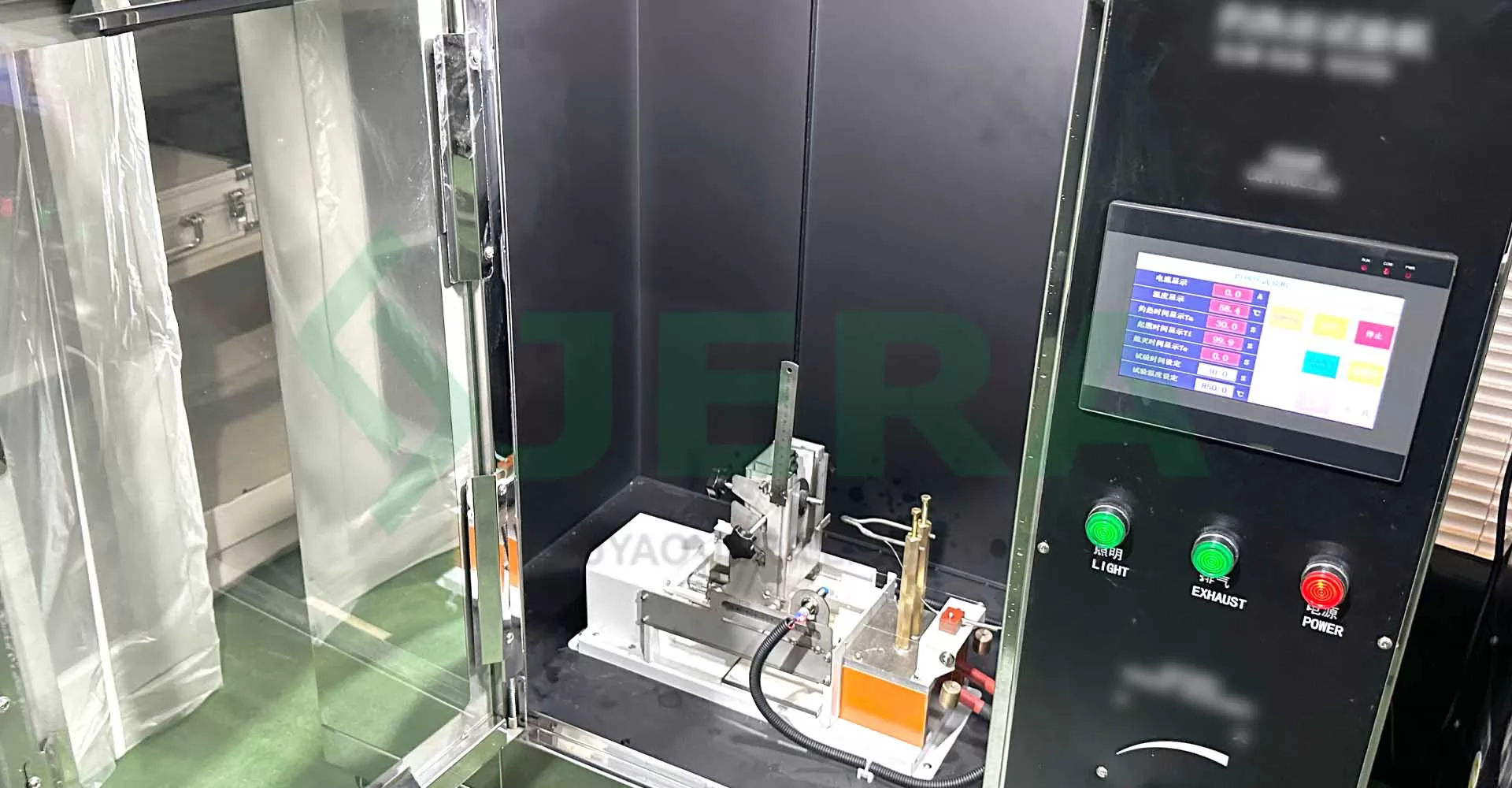
Jera Line in-house laboratory is equipped with the Glow‑Wire Flammability Test Equipment, it’s designed to evaluate the ignition resistance and fire behavior of electrical insulating materials and plastic components. It simulates the effect of overheated or glowing elements that may occur under fault conditions in electrical devices. The system complies with IEC 60695‑2 glow‑wire test standards.
Technical Specifications
Below is a typical specification set for glow‑wire test equipment:
|
Heating Temperature |
Room temperature to 1100°C, continuously adjustable; temperature measurement accuracy ±3°C, resolution ±1°C |
|
Glow Time |
0.1s to 999.9s, time range adjustable, accuracy ±0.1s |
|
Ignition Time Recording |
0.1s to 999.9s, automatic recording with manual pause |
|
Flame Extinction Time Recording |
0.1s to 999.9s, automatic recording with manual pause |
|
Glow Wire Pressure on Test Sample |
0.95N ± 0.1N, pressure limit depth 7mm |
|
Glow Wire Specifications |
φ4mm diameter, nickel-chromium alloy (80% nickel, 20% chromium), processed according to standard dimensions |
|
Thermocouple Specifications |
φ1mm diameter armored thermocouple, nickel-chromium/nickel-aluminum (K scale) |
|
Sample Release Function |
The glow wire automatically detaches from the sample after the specified glow time, complying with GB/T 4706.1-2024 requirements |
|
Material |
High-temperature spray-coated steel construction, heat-resistant and corrosion-resistant, suitable for long-term high-temperature testing environments |
Standards Compliance
Key Benefits
Application
Glow‑wire flammability test equipment is widely used in industries where fire safety and material ignition resistance are critical. Typical application areas include:
Used to evaluate polymer housings and insulating components for low‑voltage overhead line accessories.
This includes UL V‑0 fire‑proof material testing for insulation piercing connectors to ensure compliance with high‑level flammability requirements.
Testing of plastic bodies and insulating parts exposed to outdoor electrical environments
Verification of enclosure materials to ensure safe performance under thermal and electrical stress.
Assessment of ignition resistance for components used in household and industrial electrical installations.
Qualification of new polymer formulations, flame‑retardant materials, and insulating compounds.












.png)