





A type test proves a design once. It says nothing about the container that arrives eighteen months later. Three failures are worth naming at the start, because all three are common and none of them is visible in a type test report: a bolt that sheared early because the brass lot was harder than the drawing allowed, a body cast from the wrong aluminium alloy because a supplier substituted a billet, and a contact face that oxidised in a warehouse because the tin plating was too thin. A laboratory sample selected by the manufacturer in its best condition will pass. The batch that reaches site may not. All three of those failures appear in a routine test run on the batch, against the same clause set the type test used.
IEC 61238-1 was restructured in 2018, and the part number now has to match the voltage class of the product. Part 1-1 covers compression and mechanical connectors up to 1 kV on non-insulated conductors. Part 1-2 is written for insulation piercing connectors. Part 1-3 applies above 1 kV up to 36 kV.
Jera Line's mechanical shear bolt connector CCBVzT-36-4.S(H)-70-240 is a 36 kV connector produced to IEC 61238-1-3, not Part 1-1. That single line on a test report is often the difference between a document a utility accepts and one it rejects at tender stage.
This article explains what the standard actually asks for, where the specification usually breaks down, and How Jera Line controls mechanical shear bolt connector quality according to IEC 61238-1 from incoming metal to the last batch released for shipment.
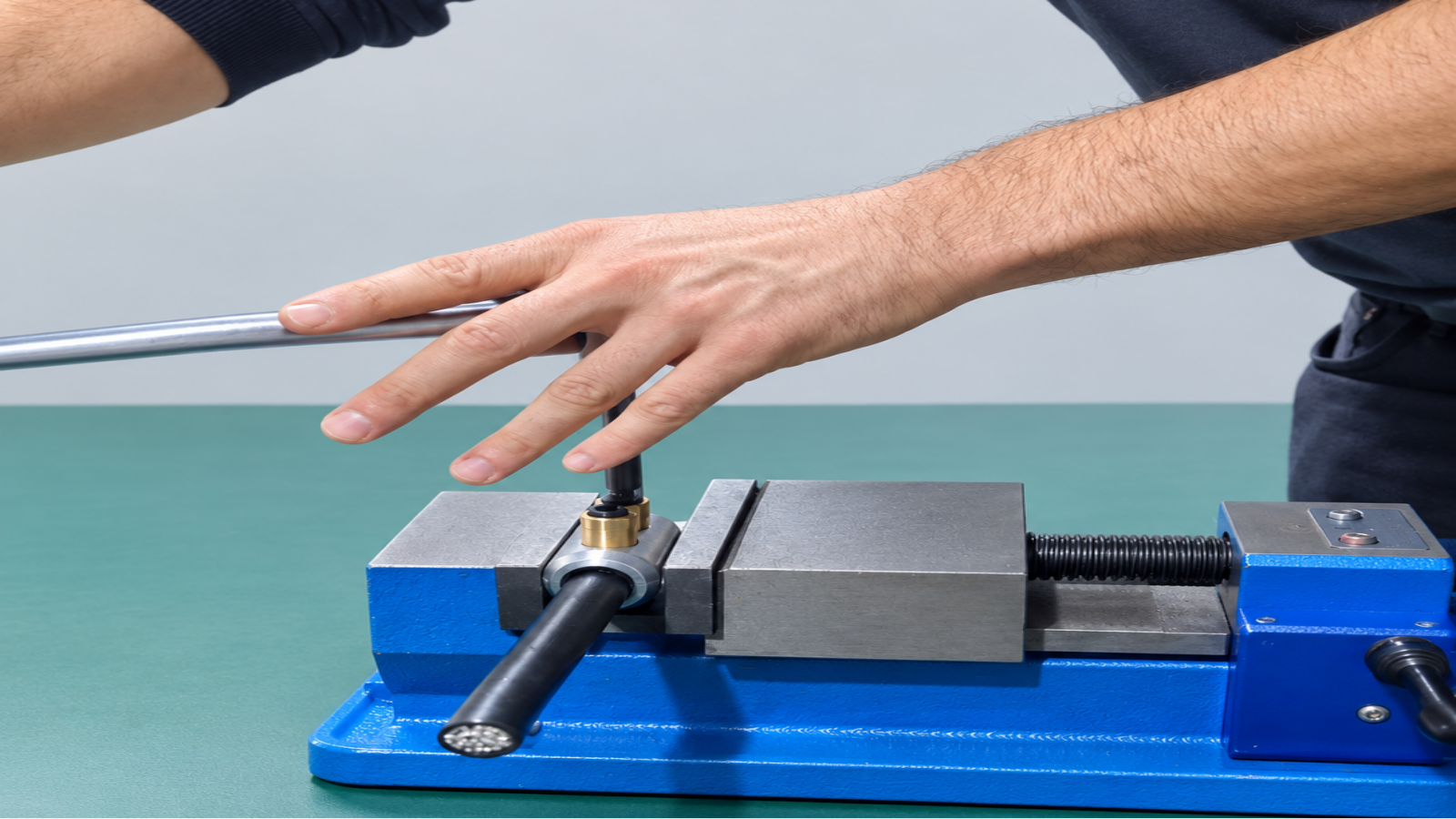
A mechanical shear bolt connector is a bolted joint in which the bolt itself is the torque control. The conductor goes into a tin-plated aluminium alloy body.
A brass shear bolt is driven with a standard hex key, and the head breaks away at a calibrated torque.
There is no press, no die set, and no torque wrench needed to re-check the joint afterwards.
That design choice is not cosmetic. Compression joints depend on a tool, a die, and an operator who follows the die schedule for each conductor size; a missed die or a tool out of calibration produces a joint that looks finished and is electrically poor.
A shear bolt joint removes those variables: the torque is built into the bolt, the tool is a hex key every crew already carries, and the break of the head tells the installer the joint is complete.
For MV work, where a re-visit costs a crew a day, that advantage matters more than the price per piece.
"Stepless" describes the thread, not the head. A stepless thread engages over its full travel for any conductor size in the range, instead of stopping at a fixed setting as a stepped design does.
On the mechanical shear bolt connector CCBVzT-36-4.S(H)-70-240, the stepless thread lets 70–240 mm² copper or aluminium be clamped across the whole range on two bolts, with no separate version for each intermediate size.
One reference covers the range, one hex key covers the reference.
IEC 61238-1turns a design into something a utility can specify.It sets an electrical class — Class A is heat cycle plus short circuit — and a mechanical class for pull-out force, judged at a stated conductor section, with the joint assembled exactly as the installer would assemble it.
Class A is the part buyers underestimate. A heat cycle test runs current through the joint and lets it cool, repeatedly, which is what a distribution network does to a joint every day for thirty years.
The short circuit test then pushes a fault current through it, which is what happens once in a while and destroys weak joints immediately.
A connector that survives both is a connector whose contact resistance stays low after thermal expansion and contraction has worked on the interface hundreds of times.
A connector that only passes a resistance check cold may still open up in service.
The mechanical class is the second half. Pull-out force is measured at a stated conductor section, and this is where catalogue wording often gets loose.
Three questions catch most of the problem before a purchase order is issued.
The first is which part of the standard the report was issued under. A supplier who says "tested to IEC 61238-1" may be quoting Part 1-1, the LV part up to 1 kV, and that report does not cover a 36 kV application. A utility reviewer who knows the standard will return it.
The correct reference here is IEC 61238-1-3, and the part number should appear on the certificate, not only in the sales email.
The second is which sections were tested. A result at 70 mm² does not extend to 240 mm². If the report shows only the small end of the range, approval for the large end is an assumption, not a test result. Ask for tested sections at both ends of your own conductor list.
The third, which is what this article is mostly about, is what the factory measures per batch.
A type test answers the first two questions for one design. It cannot answer the third for the batch you receive.

| Item | Specification |
|---|---|
| Product code | CCBVzT-36-4.S(H)-70-240 stepless mechanical shear bolt connector |
| Conductor range | 70–240 mm² |
| Conductor material | Copper or aluminium |
| Voltage class | Up to 36 kV |
| Shear bolts | 2, brass, stepless thread |
| Body | Tin-plated aluminium alloy |
| Installation | Standard hex key, no special tool |
| Type test basis | IEC 61238-1-3 |
The wider family, covering LV mechanical lugs and metering terminals, is listed in the LV terminal range on the Jera Line site. Behind the type test sits the routine programme, and that is where shipment quality is actually decided. The type test is the promise; the routine test is the delivery.
Jera Line controls mechanical shear bolt connector quality according to IEC 61238-1 through five control points that run from the goods-in gate to the packing table.
Each point maps to a clause the type test already used, so a batch either matches the approved design or it stops.
Chemical verification at incoming. Aluminium and brass lots are read on a spectrometer before they reach the line, under the raw material quality control procedure.
Alloy substitution is the quietest failure in this product: a body made from an alloy with the wrong silicon or magnesium balance machines and assembles perfectly, then corrodes or relaxes in service a year later.
Reading the lot before it is cut removes the possibility instead of detecting it afterwards.
Shear torque per batch. A lot whose bolt head breaks early or late is stopped before assembly.
Early break means the joint is under-tightened and the contact resistance will be high from the first day; late break means the installer keeps turning past the intended torque and can crush the conductor or strip the thread.
Both are batch properties of the brass and the heat treatment, so both are checked per lot rather than per drawing.
Heat cycling in our own chamber. Temperature rise and thermal cycling run on site apparatus in our laboratory testing equipment, which keeps a Class A position a routine check rather than a one-time event.
Because the chamber is in-house, a batch can be pulled and tested on the day it is questioned, without waiting for an external laboratory slot.
Resistance on finished joints. A plating or contamination defect is caught at the gate, not at energisation.
Contact resistance is measured on finished joints from each lot, so a thin tin layer or an oxidised face shows up as a number on a record instead of as a hot joint on a feeder two years later.
Records against the clause. Each lot is logged against the IEC 61238-1-3 clause set of the type test, which is what allows a utility or a lender's advisor to audit a shipment rather than a catalogue page.
Each CCBVzT-36-4.S(H)-70-240 stepless mechanical shear bolt connector orders are strictly tested in-house before shipment, and raw material is inspected before production begins. Beyond testing, the physical control matters too: moulding, metal processing and assembly all happen under one roof in a direct factory that owns its tooling, so an alloy or geometry change is re-tested by the team that made the change, not negotiated with a subcontractor.
Standard production lead time is 35–45 days from order confirmation to shipment, which is why project buyers place the purchase order as soon as the technical clause is agreed instead of waiting for the site date.
A shear bolt connector is bought on a certificate and accepted on a batch record.
Jera Line's position is that both come from the same clause: IEC 61238-1-3 for the 36 kV mechanical shear bolt connector CCBVzT-36-4.S(H)-70-240, verified by incoming chemical checks, per-batch torque and resistance testing, and heat cycling in our own laboratory.
Two limits belong here, and they are stated deliberately.
A connector is approved for the sections and materials on its report, not for every size in the catalogue, so confirm 70–240 mm² against your own conductor list. And the standard reference must match the voltage class: Part 1-3, not Part 1-1.
Send your conductor size, voltage class and the clause your specification names. We return the matching reference with its report and a free sample for your own incoming test, so your laboratory can confirm in a week what the type test promised on paper.