





Low-voltage (LV) overhead power distribution networks form the backbone of power supply for residential communities, municipal street lighting, rural grid upgrades and distributed photovoltaic stations worldwide. Insulation piercing connectors (IPCs) are the most widely adopted tapping fittings for these LV overhead networks, recognized for shear-head torque control, no-insulation-stripping installation and bimetal cable compatibility.
Among the most frequently specified IPC size classes in global LV grids is the 16/95 mm² class — a main cable range of 16–95 mm² with branch tap capacity from 4 to 35 mm². However, many electrical distributors, grid EPC contractors and new-energy integrators face pain points including long lead times, high import costs and limited customization support when sourcing branded IPC connectors for this popular size class.
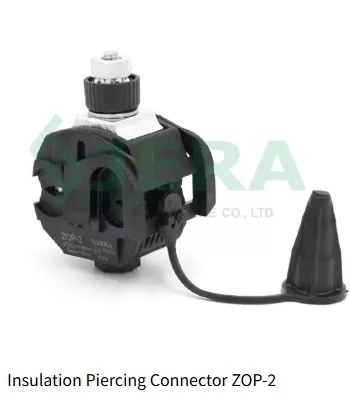
Jera Line, a professional LV & MV cable accessory manufacturer founded in 2012, developed the ZOP series insulation piercing connectors as fully interchangeable equivalents covering the 16/95 mm² main-line class, with the ZOP-2 as the core model and the extended ZOP-55 and flame-retardant ZOP-74F (ZX) covering wider and fire-critical applications.
This blog elaborates product definition, unified technical cross-reference, structural material advantages, all-scenario LV grid applications and core cooperative strengths of choosing Jera Line ZOP connectors for 16/95 mm² tapping projects.
Jera Line IPC connector 16-95 mm²raccord de piercing connecteurs is a mechanical electrical connector designed to create a branch or service connection on insulated conductors of 16–95 mm² main cable without removing the cable insulation.
The Jera Line ZOP-2 is the benchmark model of this size class: it accepts main cables from 16 to 95 mm² and branch cables from 4 to 35 mm², and is widely deployed for LV aerial bundled cable (ABC) service tap-offs across residential, commercial and municipal distribution networks. Identical to mature international IPC structure, the ZOP-2 integrates tin-coated aluminium bimetal piercing teeth, a torque-controlled shear-head bolt and a heat- and UV-resistant composite polymer body with elastomer sealing. Electricians complete live-line branch tapping without stripping cable insulation, cutting conductors or wrapping supplementary insulating tape. Serrated metal teeth automatically pierce the cable outer sheath and insulation to form stable conductive contact, while elastomer sealing rings block rainwater, coastal salt fog and dust intrusion. The calibrated shear-off aluminium alloy nut breaks automatically once reaching the standard torque value, eliminating inconsistent installation pressure caused by unskilled operators.
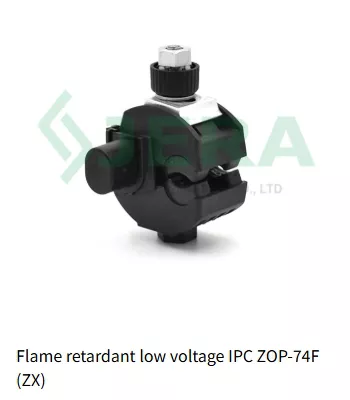
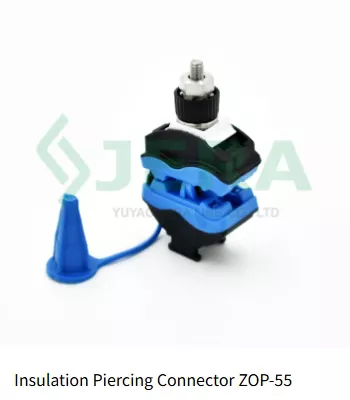
For projects needing wider cable coverage, the ZOP-55 extends the family to 16–150 mm² main and 4–50 mm² tap cables at 0.6/1 kV, while the ZOP-74F (ZX) covers 16–120 mm² main and 4–35 mm² tap cables with flame-retardant housing and tin-covered pure copper teeth for fire-critical installations.
All three models share the same 16/95 mm²-compatible footprint and the same shear-head torque logic, so contractors can standardize one family across light, medium and heavy LV tapping tasks. The family also supports the same installation tools and construction processes across all three models, so field crews trained on one model can work with the whole family without re-training. The outer shells adopt UV-resistant composite polymer via two-component insert molding, stably operating across cold northern, tropical humid and desert high-temperature LV grid environments.
All ZOP models fully pass EN-50483:4, NF C 33-020 and relevant routine and type tests inside Jera Line's in-house laboratory, with third-party certification reports available to meet global power tender document standards.
Routine and type tests according to the standards cover visual examination, dimensional and material verification, permanent marking, mechanical damage to the main conductor, branch cable pull-out, bolt tightening, shear-head function, low-temperature impact, dielectric voltage in water, low-temperature assembly, corrosion ageing, climatic ageing and electrical ageing.
| Jera Product code | Main line, mm² | Branch line, mm² | Key feature |
|---|---|---|---|
| ZOP-2 | 16–95 | 4–35 | Core 16/95 mm² IPC, EN-50483:2009 third-party type test |
| ZOP-55 | 16–150 | 4–50 | Extended range, 0.6/1 kV, NFC 33-020 + EN 50483 |
| ZOP-74F (ZX) | 16–120 | 4–35 | Flame-retardant, UL flammability, 15 N·m torque, pure copper teeth |
All Jera Line ZOP insulation piercing connectors adopt stainless steel anti-rust bolts and an integrated waterproof cavity structure, supporting mixed copper-aluminium cable connection without electrochemical corrosion risks.
Components are standardized: tin-coated aluminium or pure copper teeth, stainless steel bolts, aluminium alloy shear-head nuts, UV-resistant polymer bodies and elastomer end caps. The body and seal use heat- and UV-resistant two-component insert molding of composite polymer and elastomer, while end caps are UV-resistant polymer and washers are stainless steel.
Every raw-material batch is inspected before mass production, and each finished batch completes routine tests including visual examination, dimensional and material verification, permanent marking, connector bolt tightening, shear-head function and dielectric voltage test in water, ensuring consistent electrical and mechanical performance across different lots. Each finished production batch can provide factory test reports or third-party inspection certificates, fully complying with overseas grid tender requirements.
The ZOP-2 delivers the exact 16–95 mm² main / 4–35 mm² branch range specified in most LV service tap tenders, while the ZOP-55 and ZOP-74F (ZX) extend coverage up to 150 mm² mains and add flame-retardant options, forming a one-stop size matching solution from light household taps to heavy trunk connections.
No professional torque measuring tools are required during installation. The shear nut automatically breaks at the factory-calibrated rated torque, unifying tapping-point construction quality across entire grid projects, lowering rework rates and enabling live-line tapping without power cuts.
Tin-plated aluminium piercing teeth — and tin-covered pure copper teeth on the ZOP-74F (ZX) — form an isolation buffer between copper and aluminium conductors, eliminating electrochemical corrosion and overheating at branch joints. Electrical contractors only need one family to finish mixed aluminium main line + copper service line grid construction, cutting inventory costs and wrong-model-selection risks.
Fully enclosed cavities locked by shear bolts, with elastomer sealing filling assembly gaps, deliver stable operation in coastal salt-fog zones, rainy mountainous areas and farmland LV grids where ordinary low-grade connectors fail quickly due to moisture erosion. The UV-resistant polymer shells avoid cracking and aging under long-term outdoor sunlight exposure.
The ZOP-2 passes EN-50483:2009 type tests by an independent third-party laboratory; the ZOP-55 complies with NFC 33-020 and EN 50483; the ZOP-74F (ZX) additionally meets UL flammability standards. Factory test reports are available, so tender documents can be submitted without extra qualification adaptation costs.
The ZOP-2 and ZOP-55 are preferred choices for apartment blocks, shopping malls and community three-phase ABC overhead grids, enabling live-line power branching without cutting mains supply to reduce resident power-outage complaints.
Single-bolt ZOP-2 taps roadside lamp branches; its anti-vibration shell resists long-term vehicle vibration along traffic routes, lowering routine grid maintenance workload and extending joint service life.
The ZOP-55 matches 150 mm² aluminium trunk cables for factory power supply, stably transmitting heavy industrial current under day-night temperature alternation.
Suitable for rooftop and ground PV station grid-connected branch lines, adapting to frequent outdoor temperature fluctuations of new-energy LV grids with stable long-term conductive performance.
The ZOP-74F (ZX) is engineered for applications where fire safety is crucial, with flame-retardant material that reduces the risk of fire spread and meets UL flammability standards, minimising the risk of injury in case of fire.
Across all scenarios, the ZOP family delivers firm, consistent cable tapping that withstands wind-induced vibration, thermal cycling and atmospheric exposure over a long outdoor service life. Because one complete family covers light, medium and heavy tapping loads, contractors can simplify spare-parts inventory management while maintaining the required electrical safety standards at every project site.
For global LV grid projects requiring cost-effective, fully interchangeable insulation piercing connectors in the popular 16/95 mm² class, the Jera Line ZOP family — core ZOP-2, extended ZOP-55 and flame-retardant ZOP-74F (ZX) — delivers equivalent electrical and mechanical performance while solving the pain points of high price, long lead time and limited customization. With no-strip shear-head installation, universal copper-aluminium compatibility, full international standard certification and factory-direct cost advantages, the ZOP series has become the preferred tapping solution for power distributors, grid EPC contractors and photovoltaic integrators.
If you are sourcing reliable 16/95 mm² insulation piercing connectors for residential, industrial or photovoltaic LV overhead grids, feel free to contact the Jera Line team to apply for free test samples, download complete technical datasheets and obtain quotations tailored to your project order volume. Every batch is produced under strict in-house material control and batch-by-batch laboratory testing, so the same unified quality standard applies whether you order a sample carton or a full container shipment.












.png)